
What changes the scope of a chimney repair
Two Marin chimneys with a similar-looking crack can need very different repairs. Here are the actual factors — hillside access, older materials, structure and permitting — that change the scope of the work, with no price attached to any of them.
Published
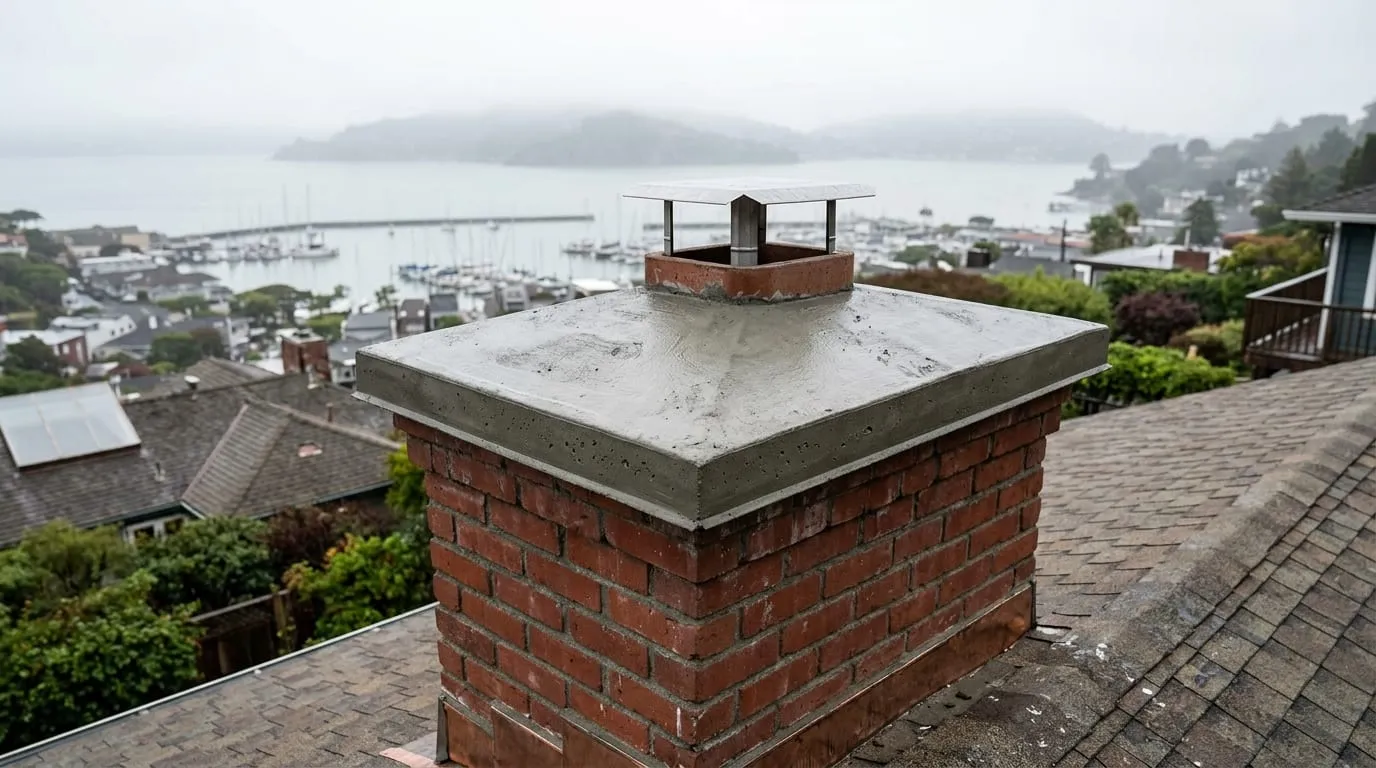
“How big a job is this?” is close to the most common thing we hear before ever laying eyes on a chimney, and it is a fair question we still cannot honestly answer over the phone — the real answer only comes into focus once an inspection has actually happened. There is no price list here, because none gets published, and how large a repair turns out to be depends on conditions no article could predict in advance. What follows instead is a straight rundown of the things that genuinely move the needle on a Marin chimney repair’s size, so a written scope makes sense once it lands in your hands.
Access gets underestimated more than anything else
The same repair on a simple single-story roof with a driveway pulled right up to the house is a fundamentally different job from that identical repair reached by a narrow stair climbing a Sausalito hillside lot, or out at a floating home in Waldo Point Harbor where every piece of equipment gets carried by hand down a dock. Extra time spent staging, careful footwork on a steep pitch, or simply the walk required to get gear onto the roof — none of that has anything to do with how much actual masonry work needs doing, yet it adds real hours regardless. Two chimneys with an identical crown repair can end up needing very different total effort once access enters the picture.
What a diagnosis uncovers that a glance never will
A crack you can see is a symptom, not the whole diagnosis. That same hairline crack in a crown might call for a simple reseal, or it might be the only visible sign of mortar deterioration that has already worked its way several courses down into the chimney’s structure — something only a hands-on inspection actually reveals. That is exactly why scoping happens after a full inspection rather than off a phone description: what shows on the surface and what the real scope turns out to be are not reliably the same thing, and a crack driven by the marine layer specifically can look minor from the ground while having done considerably more damage underneath than its appearance suggests.
Older construction calls for different materials
A chimney built within the last several decades is usually repaired with modern materials matching what is already in place. One of Marin’s early-1900s hillside or canyon chimneys — in Sausalito’s Old Town, in Mill Valley, along San Anselmo’s downtown core — is a different story: getting the mortar right often means sourcing or blending a softer, lime-based mix rather than reaching for standard modern mortar, which reacts differently against older brick and can speed up damage if applied carelessly. Matching that material correctly takes real extra time and judgment that a newer chimney’s repair simply never requires.
Cosmetic work and structural work are not the same scope
Purely cosmetic repair — repointing visible joints, resealing a crown — is an entirely different undertaking from work that touches how a chimney structurally ties into the house’s framing. That distinction matters more on Marin’s older housing stock, sitting as much of it does within reach of the San Andreas Fault trace running through West Marin: a repair addressing a structural-tie deficiency is doing substantially more than a cosmetic repointing job might appear to be doing from ground level, even when the original visible symptom looked nearly identical in both cases.
Whether a permit gets triggered
Some chimney repairs across Marin’s eleven cities need a building permit and some do not, as covered elsewhere on this site in more depth — what decides it is what the work actually touches structurally, not how big the job sounds, and which city’s building department gets involved depends entirely on the address. Getting formal sign-off adds real time to a schedule that a non-permit repointing job never has to account for, and that timeline shift is a genuine scheduling factor separate from the physical work itself.
Whether insurance enters the picture
When a repair traces back to a specific event — storm damage, a fallen limb, damage found after an earthquake — a homeowner’s insurance claim sometimes gets involved, which changes the paperwork side of the job even when the physical repair itself stays the same. Insurance documentation usually wants more detailed photos, a more specific written account of cause and effect, and occasionally a formal report format the carrier requires — all of it adding front-end time that a straightforward, non-claim repair skips entirely. Flagging this early, whenever a repair sounds insurance-related, shapes how the visit gets documented from the start.
How many issues turn up during the inspection
A chimney that has gone a long stretch without attention frequently has more than one problem developing at once — a cracked crown, deteriorating mortar, and a flashing seal failing at the roofline can all be happening together, each modest on its own but adding up to considerably more total work once combined. That is a big part of why an inspection covering the whole system, following the same path water and structural stress actually take, matters more than fixating on whatever single symptom prompted the call in the first place.
Weather affects scheduling more than scope
Fresh mortar and a poured crown both need decent weather to cure properly, and Marin’s daily marine layer along with occasional rain can shuffle a repair’s schedule more than a drier inland climate ever would. That rarely changes how big the job actually is, but it can absolutely affect the sequence of work and how long the whole thing takes start to finish — especially on a waterfront property where the marine layer tends to linger well into the morning.
The one constant: diagnosis always comes first
However these factors combine on any given chimney, the order never changes — full inspection first, a written scope spelling out exactly what was found and why it matters, and only then the actual work. Estimating from a phone call or a photo never happens, precisely because everything above only becomes clear once someone is physically looking at the chimney in question.
Getting a real scope written up
Whether it is a crack, a stain, or simply wanting an older chimney’s condition confirmed, every job here starts with a full inspection followed by a written explanation of what got found and why it matters — no estimate called out from the driveway, and nothing assumed just because of the house’s age. Coverage runs a twenty-mile radius out from central Sausalito.
Read next
More from the blog
When chimney work in Marin County needs a permit
A chimney repair that needs a permit in San Rafael may route through a completely different office than the same repair in Fairfax or unincorporated Marin. Here is what typically triggers a permit, and who to ask.
Wildfire and WUI spark-arrestor rules in Marin County
Fairfax, Mill Valley’s canyon streets and parts of Novato sit inside a genuine Wildland-Urban Interface zone under California fire code. Here is what a WUI designation actually changes about a chimney cap, and how to tell if your property is inside one.
How Mount Tamalpais' terrain affects chimney draft
Two nearly identical fireplaces a few streets apart in Mill Valley or Fairfax can draw completely differently, and the reason usually has more to do with the mountain looming over both of them than with either chimney itself.
Get an actual scope
A full inspection first, a written scope second — no verbal estimate from the driveway.