Chimney inspection · Sausalito

Chimney inspection in Sausalito

Unsure which inspection level actually applies, or whether it is even necessary?

Nothing to commit to — just call and we’ll line up a time that works.

  • Whichever level fits — a sale, routine upkeep, or after an event — gets confirmed up front.
  • A written report follows, with photos or footage attached for a Level 2 or 3.
  • Firebox access, and ideally the roof or attic too if the level in question needs it.
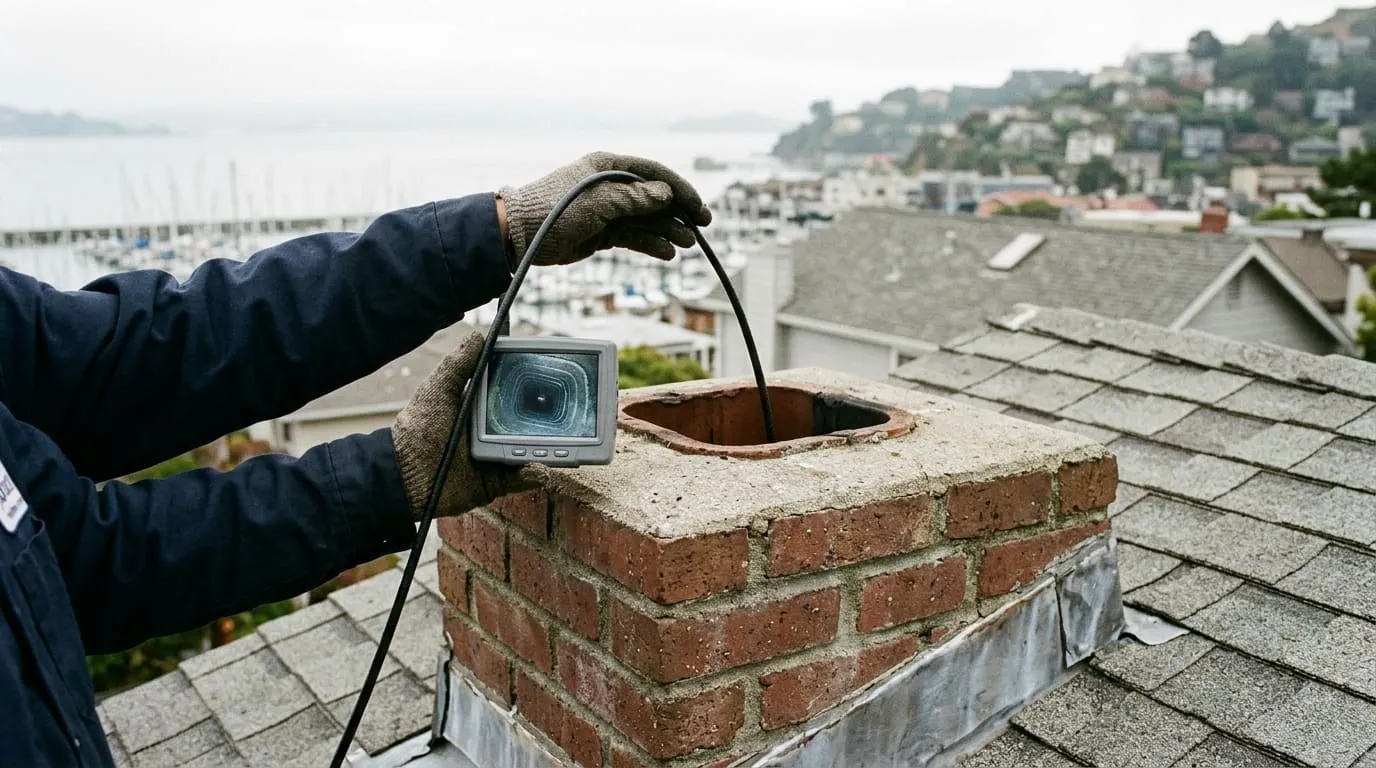
An inspection camera on a flexible rod being fed into a chimney flue in a Sausalito home, monitor screen visible

What an inspection covers

How far each level actually looks

From the visible firebox to a full camera pass down the liner — traced against the same cutaway every service on this site uses.

The short answer

An inspection is a condition review, and NFPA 211 splits it into three distinct levels rather than treating it as one generic check. Level 1 covers what a technician can see without a camera or a ladder, which fits a chimney that has stayed in continued, ordinary use. Level 2 adds a video-camera pass down the flue and is what most Marin County home sales, refinances and insurance renewals end up requiring, since it can confirm the liner’s actual condition without tearing anything open. Level 3 goes further yet, potentially opening portions of a chimney or wall to look directly at a suspected problem, and it is the level NFPA 211 points to after something has happened — an earthquake, a chimney fire, storm damage — that could have compromised a chimney that otherwise looked fine. Whichever level genuinely fits gets recommended, not whichever is easiest to sell.

Cutaway of a masonry chimney: the cap and spark arrestor at the top, then the crown, the flue liner running down inside the brickwork, the mortar joints, the flashing where the stack meets the roof, the smoke chamber, and the firebox down at the hearth.01020304050607
  1. 01Cap and spark arrestor Blocks salt spray off the harbor, drifting redwood needles and birds looking for a nesting spot from getting down the flue. Its mesh spacing is not a guess — California’s fire code and Marin County’s own Wildland-Urban Interface rules set the minimum.
  2. 02Crown The sloped cap at the very top of the stack. Down near the harbor the marine layer can blanket it for hours without a single drop of rain falling, and it is that lingering dampness — not storm totals — that starts the first hairline crack.
  3. 03Flue liner The channel that actually carries smoke out of the house. A gap or crack here is not cosmetic — it is a safety problem, since it lets heat and combustion gases reach material never meant to touch them.
  4. 04Mortar joints On an older stack, these joints are typically the first thing that gives way when the ground moves — and with the San Andreas Fault trace running through West Marin, that is a live local concern, not an imported one.
  5. 05Flashing Where the stack meets the roofline. On a hillside home in Sausalito or Tiburon, this joint has to turn water sideways off a steep pitch as much as send it downward, and a gap here is what usually shows up first as a slow stain creeping across a ceiling.
  6. 06Smoke chamber A ledge tucked just above the firebox that a straight brush pass never actually touches. In a harbor town where the air rarely stays dry for long, whatever collects on it tends to announce itself weeks later as a stale, smoky smell that will not go away.
  7. 07Firebox The one section of the whole chimney anyone actually looks at day to day — which is exactly why trouble building higher up the stack usually goes unnoticed until it finally shows itself down here.

Book this if you noticed

The usual signs

  • A home sale or purchase is in progress and documentation is required.
  • An earthquake, storm or chimney fire happened, even if nothing looks obviously off.
  • Switching from wood to gas, or putting in a new insert or liner.
  • No inspection on record, ever, or at least not in longer than a year.

Not sure which level applies to your situation? Call (628) 296-4901 and explain what’s prompting it — the right level gets confirmed before anything is scheduled.

What is included

Inspection, scoped plainly

Included

  • Confirmation of which NFPA 211 level actually fits the situation
  • A complete visual pass over every reachable component
  • Video-camera documentation of the flue interior for a Level 2 or 3
  • A written report built to hold up in a sale, refinance or insurance file

Not included

  • Repair work the inspection turns up, which is quoted and scheduled on its own
  • Engineering certification beyond the chimney itself, handled by referral to a licensed engineer when needed

Whatever repair an inspection turns up gets quoted separately as its own job — the inspection fee is the only number on the table that day.

The visit

How an inspection actually goes

  1. 1

    Confirm the right level

    The reason for the inspection — routine, a transaction, or after an event — gets asked upfront, which decides the applicable NFPA level before anything starts.

  2. 2

    Exterior and accessible interior check

    A direct visual pass covers the crown, flashing, cap, firebox and the reachable flue, at every level regardless.

  3. 3

    Camera pass, if Level 2 or 3

    A video camera travels the full length of the flue, capturing the liner’s actual condition frame by frame in spots the eye cannot follow.

  4. 4

    Component review, if Level 3

    Where damage is suspected, sections of the chimney or an adjacent wall may get opened to confirm what a camera alone cannot fully show.

  5. 5

    Written report with evidence

    A written report follows, backed by photos or saved footage for a Level 2 or 3 — documentation a lender, buyer or insurer can genuinely rely on.

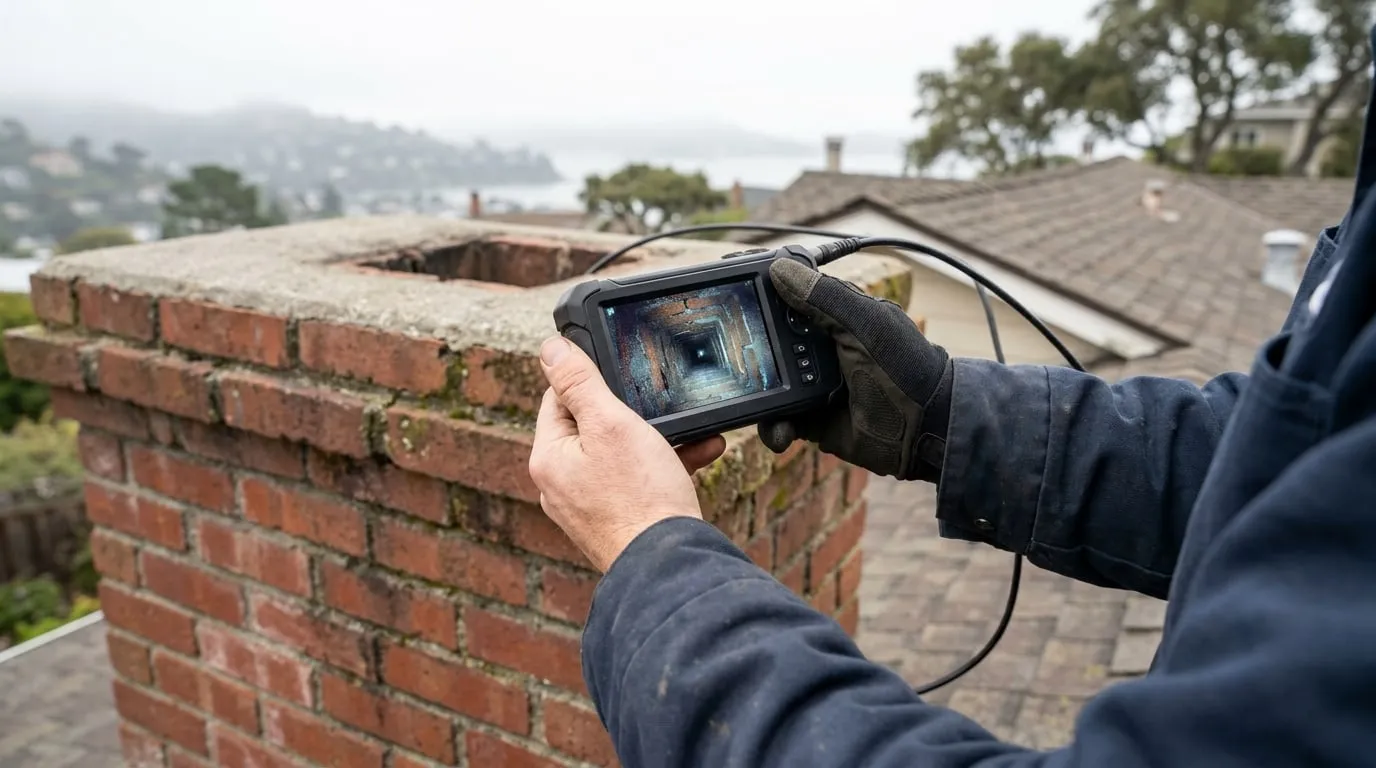
A technician viewing a live camera feed on a monitor while inspecting the inside of a chimney flue in a Marin County home

Inspection specifications

Inspection levels, by NFPA 211

The three levels the standard itself lays out, and the situation each one is meant for.

Level 1
Visible, accessible areas — routine, continued use
Level 2
Adds video camera — sale, refinance, insurance, after an appliance change
Level 3
May remove components — after damage or a suspected hidden hazard
Recommended after
Any earthquake, chimney fire, or severe storm
Typical Level 2 duration
60–90 minutes

NFPA 211: Standard for Chimneys, Fireplaces, Vents, and Solid Fuel-Burning Appliances.

In detail

The three levels, and when each applies

Why Marin real estate leans on Level 2, and when the standard calls for a Level 3.

01One term, three actual meanings

People say “chimney inspection” as if it were a single fixed thing, but NFPA 211 — the standard governing this across the industry — actually breaks it into three separate levels, each built for a different circumstance.

Continue reading

Level 1 is the everyday baseline: a visual pass over everything reachable without a camera or ladder, appropriate when a chimney has been in steady use with nothing recent to raise a flag. Level 2 adds a camera pass down the full flue, capturing the liner’s condition in ways a flashlight and mirror never could. Level 3 goes furthest, potentially opening sections of the chimney or an adjoining wall to look directly at a suspected issue, and it is reserved for cases where something concrete already points toward hidden damage.

Mixing these up, or reaching for whichever sounds least involved, is how a buyer ends up with a report their lender rejects, or how a homeowner skips a genuinely warranted Level 3 after real damage simply because a quick Level 1 glance looked fine.

02Marin’s real estate market runs on Level 2

Home sales in Marin move fast, and a chimney inspection is a standard part of due diligence on nearly any older home with a fireplace — which covers a wide swath of the county’s hillside and canyon properties, Sausalito through Mill Valley included.

Continue reading

What a transaction needs above all is proof a third party can trust without cracking the chimney open themselves: a recorded camera pass showing the liner’s real condition, paired with a written report. A Level 2 delivers exactly that, which is why it has quietly become the default for a sale, a refinance, or an insurance renewal locally, even on a chimney showing no obvious trouble at all.

03An earthquake changes what the standard requires

NFPA 211 does not leave this to interpretation: once an event has potentially threatened a chimney’s structural integrity — an earthquake, a chimney fire, a severe storm — the correct response jumps to a Level 3, skipping past Level 1 or 2 entirely.

Continue reading

That distinction carries real weight in Marin because the San Andreas Fault trace runs through West Marin near Point Reyes and Bolinas, making the kind of earthquake damage a masonry chimney can suffer — a hairline crack along a mortar joint, a shift in how the structure ties into its framing — an actual recurring risk rather than a hypothetical one. Much of that damage stays invisible to a simple look, and even a camera pass down the flue interior will not catch a problem hiding in the surrounding wall. A Level 3, which can mean opening part of the chimney or an adjacent wall for a direct look, exists precisely for this situation.

04What actually ends up in the report

No matter the level, an inspection wraps up the same way: a written report kept on file, not a verbal rundown at the door.

Continue reading

A Level 1 report lays out plainly what got checked and what turned up. A Level 2 or 3 report adds photographs or saved footage from the camera pass — thorough enough that a buyer’s agent, a lender, or an insurance adjuster can review it on their own, without relying on someone else’s secondhand summary.

05Booking an inspection around Sausalito and Marin County

Whatever is prompting the call — a pending sale, a recent earthquake or storm, swapping to a new appliance, or simply not remembering the last time — that reason determines the right level before anything gets scheduled.

Continue reading

Coverage runs across a twenty-mile radius from central Sausalito, and the resulting report is built to hold up for whoever actually has to read it.

Reviews

What the last 12 customers actually said

5.0

12 Google reviewscounted 2026-08-26

  • 512
  • 40
  • 30
  • 20
  • 10
  • Jillian Hodapp

    Heavy soot buildups around the chimney exit and the termination cap screen had to be swept away to stop persistent smoky backdrafts on windy nights.
  • Daniel Rodriguez

    Extensive soot discoloration on the fireplace brick ceased after a thorough cleaning that removed a significant draft blockage inside the smoke chamber corbels.
  • Angela Parker

    They had camera gear that allowed us to see the whole vertical flue way. It was good to see that our clay tiles had come throughout the severe winter without breaking.
  • david gabay

    Great service from start to finish! They were professional, on time, and left everything clean. Highly recommend for any chimney work.

Read all 12 reviews on Google

Questions

What people ask about inspections

Which inspection level does selling a Marin County home require?

Most transactions call for a Level 2, adding a video-camera pass through the flue — documentation a buyer’s inspector or lender can review directly without opening the chimney themselves.

Does an earthquake warrant getting the chimney inspected?

A visible crack or lean is worth calling about regardless, and NFPA 211 specifically points to a Level 3 — its most thorough tier — after an event like an earthquake that could have compromised a chimney that appeared fine beforehand. With the San Andreas Fault trace running through West Marin, this is a genuine local concern rather than a remote one.

What’s the time commitment for a Level 2 inspection?

Usually 60 to 90 minutes for one flue, camera pass and written report included — expect longer with multiple chimneys, hillside terrain, or access that is more limited than usual.

Will a Level 1 cover a chimney used every winter?

For one in continued, ordinary use with nothing recently changed and no damage suspected, yes — that is precisely the level already bundled into a standard sweep visit.

Is an inspection needed before switching from wood to a gas insert?

Yes — an appliance swap is specifically one of the situations NFPA 211 flags for a Level 2, since a gas insert’s venting needs differ from whatever the flue was originally sized for as a wood-burning setup.

Book an inspection

Tell us why you need it — sale, routine or post-event — and we will confirm the right level.

Or call (628) 296-4901 to book directly.

Tell us what changed.

Tell us what the fireplace is doing and what changed. Someone reads every message that comes in.

Nothing to commit to — just call and we’ll line up a time that works.

Prefer to talk? Call (628) 296-4901 — we’ll confirm when we can help.