Chimney cleaning · Sausalito

Chimney cleaning in Sausalito

If a sweep already clears the flue, what is left for a cleaning to reach?

Nothing to commit to — just call and we’ll line up a time that works.

  • Somewhere around 60 to 90 minutes for one fireplace, start to finish.
  • The smoke shelf hand-cleaned, the ash pit cleared, and the damper checked.
  • Firebox access, plus the ash-pit door if the fireplace has that feature.
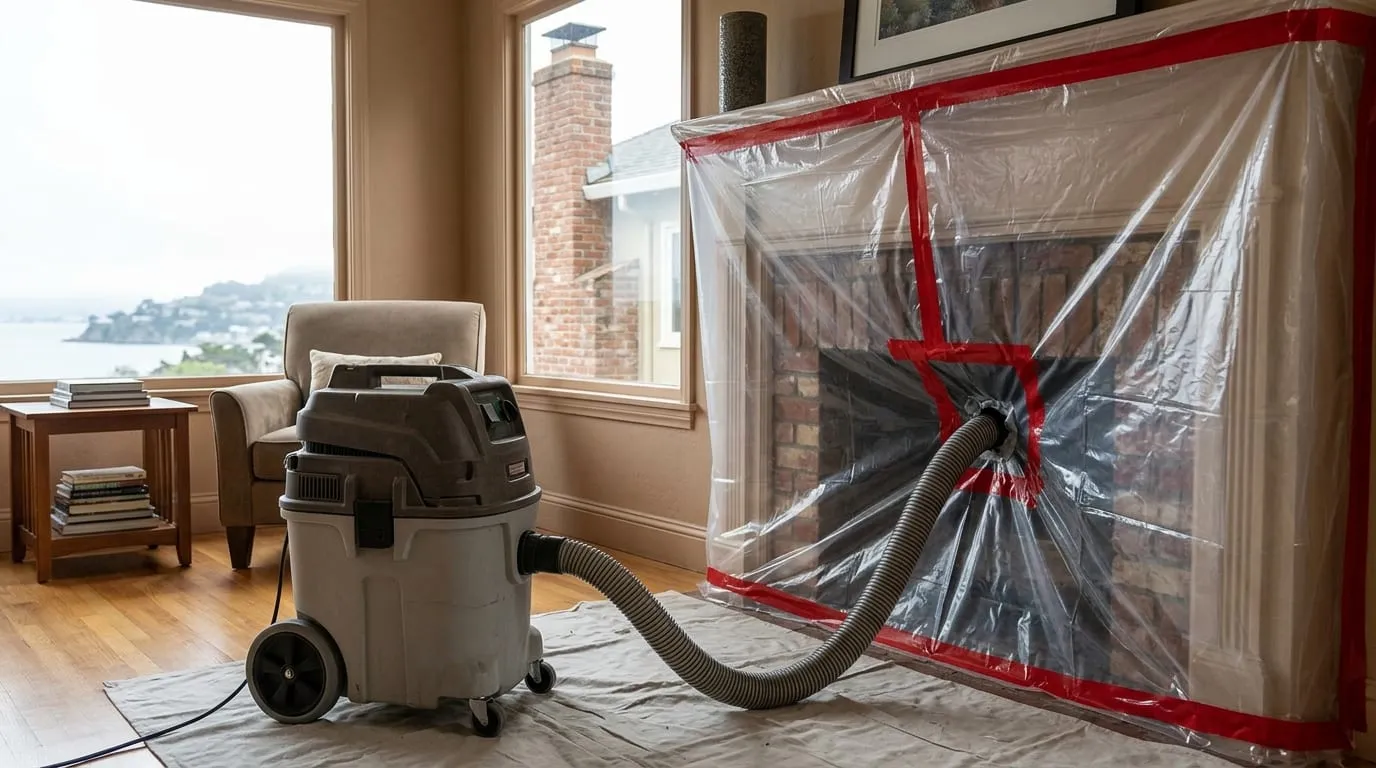
A HEPA extraction vacuum hose sealed into a firebox opening during a deep chimney cleaning in a Sausalito home

What cleaning covers

Where a sweep does not reach

The smoke shelf, the damper and the ash pit — traced against the same cutaway every service on this site uses.

The short answer

A cleaning visit picks up where a standard sweep stops: the smoke chamber shelf sitting above the firebox, the damper mechanism, and the ash pit underneath — none of which a brush traveling straight up the liner ever comes close to touching. The smoke shelf especially collects debris, old creosote and even nesting material over years of use, and it is frequently the real source of an odor that lingers even after the flue itself has been swept. Around a damp harbor town like Sausalito, where a fireplace can sit unused for long stretches between fires, that shelf and the ash pit below it can go years untouched simply because nothing beyond the standard sweep ever looks that far. This visit opens the smoke chamber, hand-cleans the shelf, vacuums out the ash pit, and checks the damper seal — covering exactly the parts of the system that keep a house smelling like last winter even once the flue is spotless.

Cutaway of a masonry chimney: the cap and spark arrestor at the top, then the crown, the flue liner running down inside the brickwork, the mortar joints, the flashing where the stack meets the roof, the smoke chamber, and the firebox down at the hearth.01020304050607
  1. 01Cap and spark arrestor Blocks salt spray off the harbor, drifting redwood needles and birds looking for a nesting spot from getting down the flue. Its mesh spacing is not a guess — California’s fire code and Marin County’s own Wildland-Urban Interface rules set the minimum.
  2. 02Crown The sloped cap at the very top of the stack. Down near the harbor the marine layer can blanket it for hours without a single drop of rain falling, and it is that lingering dampness — not storm totals — that starts the first hairline crack.
  3. 03Flue liner The channel that actually carries smoke out of the house. A gap or crack here is not cosmetic — it is a safety problem, since it lets heat and combustion gases reach material never meant to touch them.
  4. 04Mortar joints On an older stack, these joints are typically the first thing that gives way when the ground moves — and with the San Andreas Fault trace running through West Marin, that is a live local concern, not an imported one.
  5. 05Flashing Where the stack meets the roofline. On a hillside home in Sausalito or Tiburon, this joint has to turn water sideways off a steep pitch as much as send it downward, and a gap here is what usually shows up first as a slow stain creeping across a ceiling.
  6. 06Smoke chamber A ledge tucked just above the firebox that a straight brush pass never actually touches. In a harbor town where the air rarely stays dry for long, whatever collects on it tends to announce itself weeks later as a stale, smoky smell that will not go away.
  7. 07Firebox The one section of the whole chimney anyone actually looks at day to day — which is exactly why trouble building higher up the stack usually goes unnoticed until it finally shows itself down here.

Book this if you noticed

The usual signs

  • An odor that sticks around in the room even after a sweep.
  • Ash or debris sitting in the firebox that a normal sweep never seems to clear.
  • A damper that sticks, won’t seal properly, or rattles when it moves.
  • A fireplace that has gone a year or two without being used at all.

Not sure cleaning is what’s actually needed? Call (628) 296-4901 and tell us what you’re noticing — we will figure out the right visit together.

What is included

Cleaning, scoped plainly

Included

  • Hand-cleaning of the smoke chamber shelf
  • A complete vacuum-out of the ash pit
  • A check of the damper’s seal and range of motion
  • Protection kept over the floor and hearth for the whole visit
  • A written note covering anything found, handed over before we leave

Not included

  • The flue-liner brush pass, which is part of a standard sweep and can be booked alongside this visit
  • Any damper repair or replacement the check turns up, quoted separately as its own job

The flue-liner brush pass and any repair sit outside this scope entirely, each priced on its own — a cleaning visit will not quietly balloon into something bigger.

The visit

How a cleaning actually goes

  1. 1

    Floor and hearth protection

    Coverage goes down along the hearth and the whole path in, just as it would for a sweep.

  2. 2

    Open the smoke chamber

    The shelf sitting between the firebox and the flue is opened up and hand-cleaned of whatever debris and old creosote has built up there.

  3. 3

    Empty the ash pit

    A sealed vacuum reaches all the way into the ash pit, clearing out debris a routine sweep never touches.

  4. 4

    Check the damper

    The damper gets cycled through its full range of motion and checked for a proper seal once closed.

  5. 5

    Written notes

    Whatever the visit turns up — a crack in the smoke shelf, a damper that won’t seat right — is written down before anyone leaves.

A HEPA extraction vacuum hose sealed into a firebox opening during a deep chimney cleaning in a Sausalito home

Cleaning specifications

Cleaning, by the numbers

Where a deeper clean actually gets to, held against the same standard a sweep is measured against.

Smoke shelf
Hand-cleaned, not just brushed past
Ash pit
Fully vacuumed, sealed extraction
Damper
Checked for seal and free movement
Debris handling
Sealed HEPA vacuum, floor protected
Typical visit length
60–90 minutes

NFPA 211: Standard for Chimneys, Fireplaces, Vents, and Solid Fuel-Burning Appliances.

In detail

What cleaning reaches, and why it matters

The mechanics of the smoke shelf, the ash pit and the damper — and why a smell can outlast a sweep.

01Where a standard sweep stops short

Running a brush straight up the flue liner is deliberately narrow work — it clears the single passage smoke actually travels through, nothing more.

Continue reading

A masonry fireplace, though, has other spaces built into it that a liner brush was never designed to reach: the smoke chamber, a shelf that widens out directly above the firebox where the flue tapers into the liner; the damper, the metal plate controlling the throat of the fireplace; and, in plenty of older Marin homes, an ash pit tucked beneath the firebox floor behind its own small cleanout door.

Each of those spots accumulates its own kind of mess over the years — soot and creosote flaking onto the smoke shelf, ash piling up below the firebox, the damper itself corroding — and none of it clears on its own. A flue can be freshly swept and perfectly clear while every one of those other spaces still carries years of buildup.

02The smoke shelf is usually where the smell comes from

When a homeowner calls about a lingering smell that survived a recent sweep, the smoke shelf is almost always the culprit.

Continue reading

Positioned right above the firebox opening, it catches debris falling from the chamber above and, because its shape curves it out of a brush’s straight-line path, rarely gets touched during a routine sweep. Creosote sitting there keeps giving off a faint burnt smell for far longer than most people expect, and the damp harbor air around Sausalito holds onto that odor longer than a drier inland location would. Cleaning that shelf by hand, rather than counting on a brush to dislodge it in passing, is typically what finally clears a smell a sweep alone could not.

03Why an ash pit matters most on a fireplace that barely gets used

A number of Marin’s older hillside homes were built with an ash pit — a small cleanout chamber under the firebox floor, closed off by its own little door, designed to let ash simply fall through instead of being shoveled out after every fire.

Continue reading

Over the years, particularly in a fireplace used only occasionally, that pit can fill up considerably without anyone realizing it, tucked as it is below the visible firebox. A pit packed full restricts airflow and can trap moisture against the surrounding masonry. Getting it out calls for a sealed vacuum rather than a shovel and bucket — the same HEPA extraction used on the flue keeps fine ash from clouding the room the moment that cleanout door swings open.

04What the damper does, and why it gets a look here

A damper pulls double duty: closed, it seals the flue against escaping conditioned air when the fireplace sits idle, and open, it clears a full path for smoke once a fire is going.

Continue reading

Salt-laden air off the harbor can corrode one over time, warping it slightly or simply leaving it stiff from disuse, and either failure mode is a problem — constant air leakage on one end, smoke pushed back into the room on the other. Checking it takes only a few minutes as part of a cleaning visit: cycle it through its full range, confirm the seal closes properly, and flag anything that will need more than cleaning to resolve.

05Booking a cleaning around Sausalito and Marin County

Whether it has simply been a couple of years since anything past the flue itself got looked at, or a fireplace has sat idle for a while and needs a check before its next fire, this is the visit built for exactly that.

Continue reading

Coverage extends across a twenty-mile radius from central Sausalito, including the floating-home community at Waldo Point Harbor, and a straight answer on whether a sweep, a cleaning, or both make sense comes before any work starts.

Reviews

What the last 12 customers actually said

5.0

12 Google reviewscounted 2026-08-26

  • 512
  • 40
  • 30
  • 20
  • 10
  • Jillian Hodapp

    Heavy soot buildups around the chimney exit and the termination cap screen had to be swept away to stop persistent smoky backdrafts on windy nights.
  • Daniel Rodriguez

    Extensive soot discoloration on the fireplace brick ceased after a thorough cleaning that removed a significant draft blockage inside the smoke chamber corbels.
  • Angela Parker

    They had camera gear that allowed us to see the whole vertical flue way. It was good to see that our clay tiles had come throughout the severe winter without breaking.
  • david gabay

    Great service from start to finish! They were professional, on time, and left everything clean. Highly recommend for any chimney work.

Read all 12 reviews on Google

Questions

What people ask about cleaning

How is chimney cleaning different from a sweep?

A sweep is focused on the flue liner itself. Cleaning goes further, into the smoke chamber shelf, the ash pit and the damper — spots a brush traveling straight up the liner simply never reaches.

Why does the fireplace still smell after being swept?

That smell is usually coming from the smoke shelf or the ash pit rather than the flue itself. Debris and old creosote settle there over years, and a standard sweep is not built to reach it — which is exactly the gap a cleaning visit fills.

Should both a sweep and a cleaning be booked together?

In most cases, yes, if it has been a while since either was done — for a fireplace unused for a year or more we typically pair them, since both benefit from the same floor protection and access setup.

Do you clean fireplaces on houseboats out at Waldo Point Harbor?

We do — a floating home’s fireplace or stove collects debris in the same spots as any other, and the same sealed-vacuum method applies; just flag it as a floating structure when booking so access gets planned properly.

Can a stiff or rattling damper get fixed during a cleaning?

The mechanism gets checked and lubricated as part of the visit, which clears up most stiffness. One that is bent, corroded through, or will not seal at all needs its own separately quoted repair or replacement.

Book a cleaning

Tell us how long the fireplace has stood unused, if you know — we will confirm the right visit.

Or call (628) 296-4901 to book directly.

Tell us what changed.

Tell us what the fireplace is doing and what changed. Someone reads every message that comes in.

Nothing to commit to — just call and we’ll line up a time that works.

Prefer to talk? Call (628) 296-4901 — we’ll confirm when we can help.